Skip to content
Unknown's avatar

International Photonics and Outreach

  • Home
  • Contact

Tag: Public engagement

A wee school trip to Scotland

Fàilte!

I am in St Andrews, Scotland, for the 2018 Summer School in Innovation and Entrepreneurship in Photonics. The school is organised by the UK’s Engineering and Physical Sciences Research Council’s (EPSRC) Centre for Doctoral Training in Applied Photonics and is hosting an impressive list of experts from many branches of the photonics sector. I look forward to gaining some varied perspectives on drivers and lessons learnt in photonics-driven technological innovation.

Invited speakers at the 2018 Summer School in Innovation and Entrepreneurship in Photonics.
Invited speakers at the 2018 Summer School in Innovation and Entrepreneurship in Photonics. Photo source @cdtap.

Why the need for such a summer school for postgraduate and early-career professionals? The organisers have described the motivations very succinctly:

The worldwide photonics market is worth $150 billion. Graduate schools around the world are producing excellent photonics researchers, but achieving sustainable economic impact makes it important to stimulate a spirit of enterprise, technology transfer, innovation and entrepreneurship in this community of early career researchers.

The attendees will likely be postgraduate researchers and early-career professionals, and it will be a great opportunity to meet to discuss their work in photonics and applications in industry and academia.

As part of the summer school I will also present work in the development of integrated waveguides and gratings for integrated optical gyroscopes for potential applications in navigational systems, which has stemmed from work in my PhD and an international collaboration with researchers from Zhejiang University in China (as described in a previous post). I am also excited to be exploring an idea I have for a consultancy service to improve the “STEM fluency” in public and private organisations wanting to make more efficient Impact in their work in their local community.

I wish to take the opportunity to thank the organising committee for awarding me a bursary to have the privilege of attending this summer school. More to follow in the coming days, so make sure that you subscribe to my updates from the website!

Matthew Posner Engaging with research, News Jun 17, 2018 1 Minute

Educating educators

“Education breeds confidence…

I am attending the 14th International Conference on Education and Training in Optics and Photonics that is hosted at Zhejiang University, Hangzhou, China. This bi-annual meeting brings together educators from all over the world: this year 230 participants from 28 countries have travelled to Hangzhou to attend ETOP. In the history of this conference, 866 papers have been written to report development on novel teaching methods for students from primary schools to senior postgraduate levels, including 110 on outreach endeavours. I co-authored a paper at the 2015 ETOP event on the outreach program that I have led in Southampton (open access online), but this is my first time in attendance. It is a humbling and inspiring experience to be surrounded by experienced educators that have been advancing teaching in their communities for many years.

Confidence breeds hope…

The plenary session of the conference was “presented” by Eric Mazur. I use inverted commas for presented as this was a masterpiece in engagement, an incredible live demonstration of an educating exercise. It explored the meaning of teaching, illustrated by a live demo of active learning, which gave me that ah-ha moment when I realised how Archimedes’ principle worked (note to self: volume is really important). I have never thought much about my teaching. I have put myself in positions where I could do it, I have enjoyed the process of finding what works, and developed my teaching platform through experienced mentors, peer-collaboration and practice. The talk was a good opportunity to reflect.

"Innovating Education to Educate Innovators", Eric Mazur, 2017 President of the Optical Society and the Harvard University Dean of Applied Physics, ETOP2017 plenary talk. Photo credit Chad Stark.
“Innovating Education to Educate Innovators”, Eric Mazur, 2017 President of the Optical Society and the Harvard University Dean of Applied Physics, ETOP2017 plenary talk. Photo credit Chad Stark.

How do I understand Teaching now? Teaching is the construction of knowledge. It must be an emotional process, to be efficient. The student goes through the steps of reflection, opinion-forming and discussion to become better informed. The teacher has a role to facilitate the transfer of information, by offering students her/his experience and giving them resources (books, course notes, etc.) to acquire this. The class becomes a safe communal space for peer-learning, with teachers for mentoring, and where students can connect the information with their personal experiences.

Hope breeds peace.” Confucius

At a time of international turmoil, education must serve the purpose of enlightenment. Offering children and adults those “ah-ha” moments is key. Experiencing and engaging with science, research and their applications to their everyday lives are vital ingredient to building knowledge in society. If those smiles I have seen in my education experience can be transferred to everyone’s daily lives, then I feel, candidly perhaps, that the world will be a better place.

Matthew Posner Engaging with research, News May 30, 2017 2 Minutes

Heading East

I’m excited to be travelling to China. I’m on my way to Hangzhou, which is a couple hours away from Shanghai. This will be a relatively short trip, and a good opportunity to revive the blog with news and pictures of where my research and outreach activities take me! Thanks for tuning in, expect 2-3 posts a week over the next fortnight.

Next week I will be presenting a paper at the 14th International Conference on Education and Training on Optics and Photonics (ETOP) on organising science classes in places where you wouldn’t expect them. This is based around a couple of events, one that I run at the 2016 Winchester Cathedral Primary Science Festival, and another show on particle physics that co-author Alex Jantzen did at Salisbury Cathedral. You’ll read (and see) more about that in due course!

Finding new places for teaching: optical sciences workshops in Winchester Cathedral.

I will also be visiting Zhejiang University to meet with potential collaborators on research projects. I posted a while back on the research I am doing to build photonics integrated circuits to make polarisation filters. An application of these filters is to enhance optical integrated gyroscopes, a type of sensor that can be used for navigation in aerospace or satellites for instance. The polarisation of light in these circuits can cause unwanted sources of noise that are detrimental to the signal they are trying to sense. The technology I’ve been developing could offer a significant improvement of the “signal-to-noise” ratio in these devices. I am looking forward for the opportunity to present my research and find out about work happening in Zhejiang.

I was very near Guangzhou in 2008, but I never visited. Back then I spent time in Shanghai, studying Mandarin Chinese at Fudan University. The memories are great, alas the language skills not so good anymore! I have found that Chinese is an unforgiving language, which will slip away without regular practice! I imagine that in the past 9 years Shanghai has changed a lot, and I’m looking forward to catch up with people and see how things have changed!

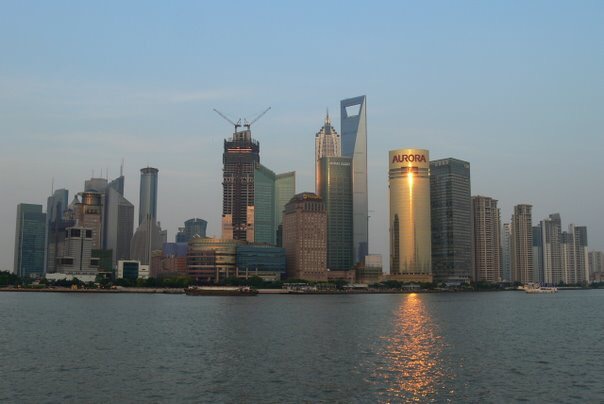
The Shanghai Bund, July 2008.
The Shanghai Bund, September 2008.

This trip will not have been possible without the support of a few organisations, and I am grateful for receiving travel grants from the IOP Physics Communicators Group, Zhejiang University, the University of Southampton EPSRC-funded Future Photonics Manufacturing Hub and Impact Acceleration Account.

Matthew Posner Engaging with research, News May 26, 2017 2 Minutes

Thanks

Thank you for following

The first episode of my travels and research in North America is drawing to a close. It’s been wonderful and I have many people to thank.

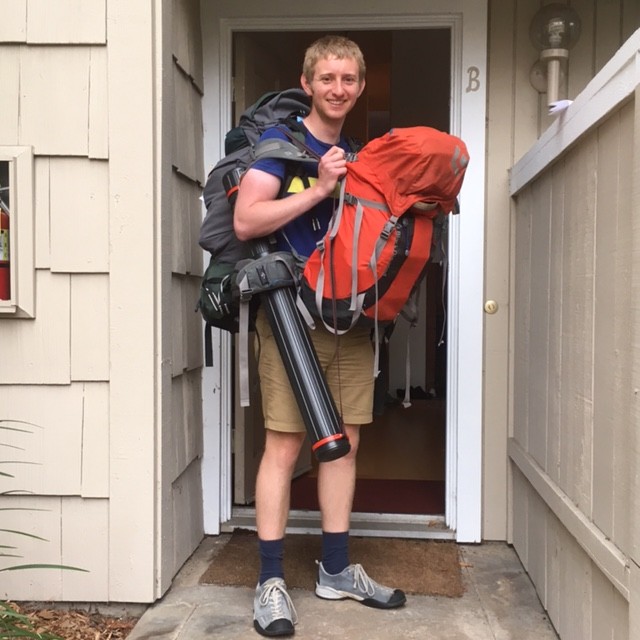
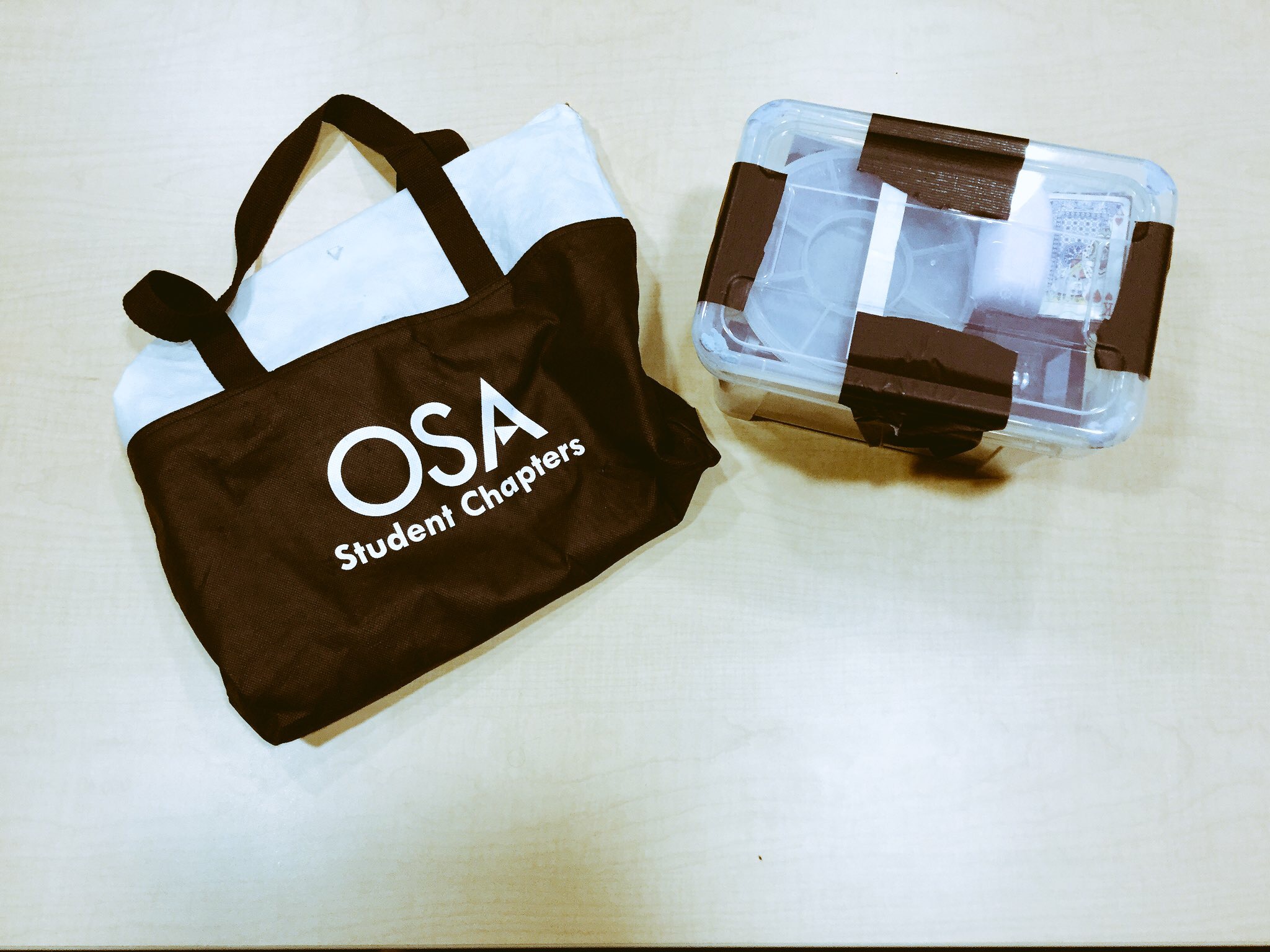
Large back packs and a poster tube for research and travel.

I have visited people in 9 universities and 3 companies in the last 8 weeks. Thank you for giving me your time. I have enjoyed having the opportunity to discuss my research, my outreach & education work, and my plans for the future. It has been a true pleasure to meet you and find out what you do and what drives you.

Thank you to the organisations that have supported me throughout: the OSA, the SPIE, the University of Southampton and its’ Optoelectronics Research Centre, for providing me with the means and the networks to reach out to places far and wide and assist me in crafting my research adventure.

Thank you to all the people that I have met along the way. The new meetings have been rich and inspiring, the reunions have been great. I wish that I will see you again soon.

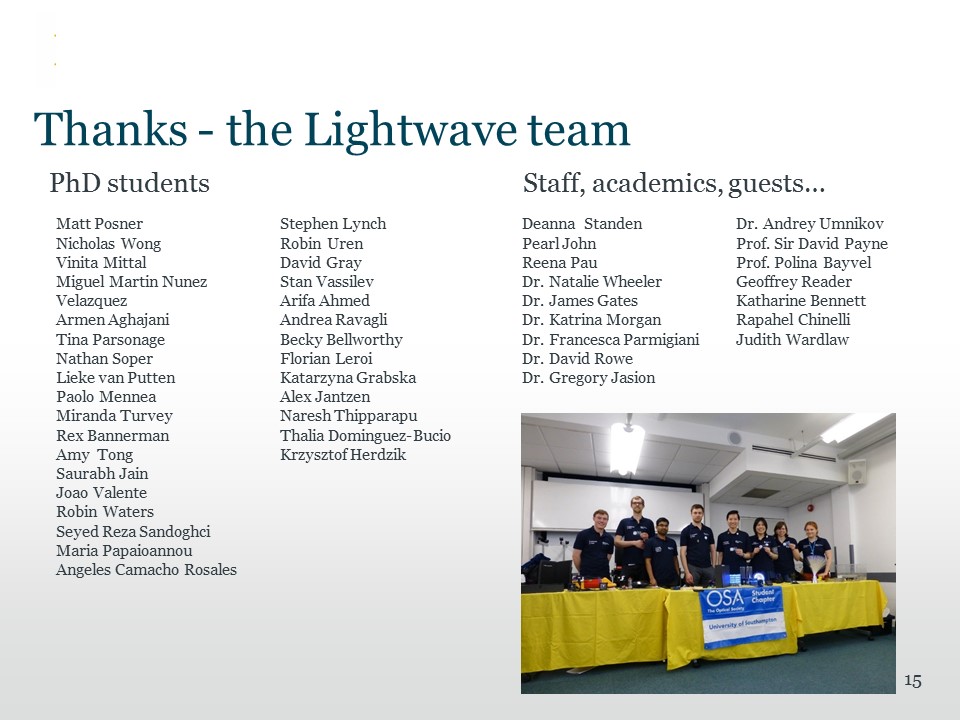
Thanks to the Lightwave team
A Powerpoint-thanks to the Lightwave team, as seen during my conference presentations.

Thank you to all of you that got me here, kept in touch, and followed the blog; you, unknowingly perhaps, kept me going throughout. My supervisors, Peter and James, for letting me go ahead with this project. Stephan, for encouraging me to blog and enhancing this space with cool maps, videos and a subscriber mailing list. The Lightwave team, all of you who make me feel a part of this wonderful community of research, education and inspiration; it was an honour to present our work at an international conference and tour our kit across North America. And of course, my family, and Mum, Dad, Rebecca for being there, always; and Becky, love of my life.

Thank you all

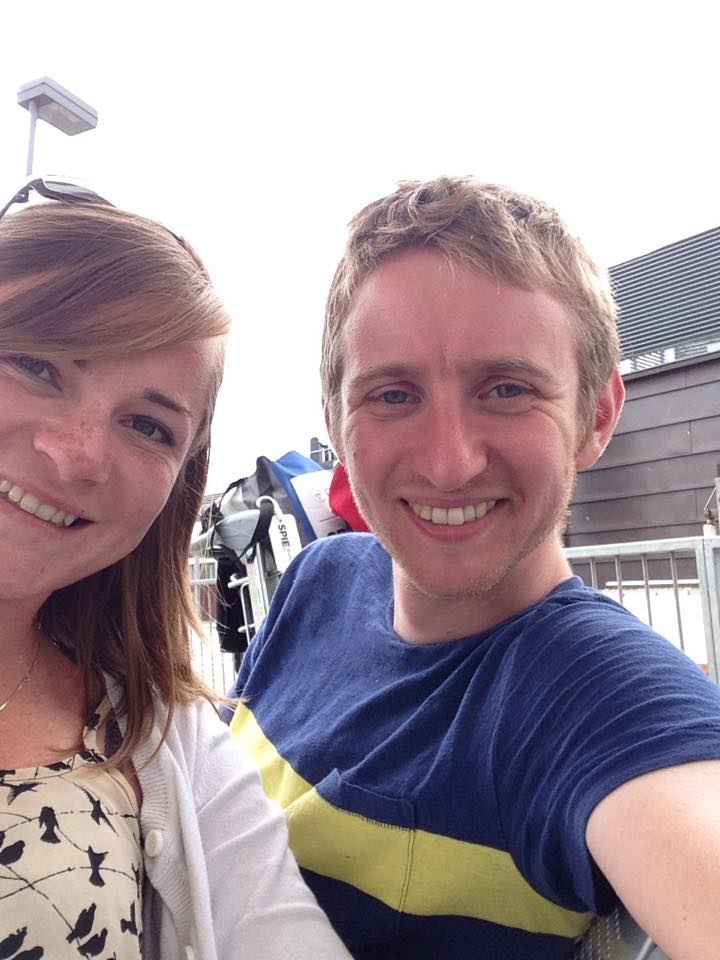
A surprise reunion with Becky at London Heathrow on my way back!
A surprise reunion with Becky at London Heathrow on my way back.
Matthew Posner Cycling, Engaging with research, News, Reunions, Travel Sep 10, 2016 1 Minute

World classes

Last week I attended an international conference called Optics Education and Outreach IV (IV because it’s the 4th time it’s run!), which was held at the SPIE Optics + Photonics 2016 congress. I presented work that I and colleagues from the University of Southampton carried out during the 2015 International Year of Light (IYL 2015). IYL 2015 was proclaimed by UNESCO to recognise and celebrate the importance of light and light-based technologies for society, healthcare, education, environment, economy and as a means to connect the world.

2015 was proclaimed the International Year of Light by the United Nations to raise awareness of light sciences and its applications.

The conference was inspiring. It brought together a rich mix of researchers, educators and industry professionals to present outreach and education activities running around the world. Truly world-class. Words cannot begin to capture the diversity, enthusiasm and richness of what is going on. The work will eventually appear in an open access journal, and I will update this page when it becomes available.

I and, I felt, all of the authors sought to present our work on the world stage to inspire and inform. I had the pleasure to write 3 papers with 12 incredible human beings that go by the label of researchers:

  1. Class-based outreach led by postgraduate students for school pupils. I presented types of activities that are suitable for working with schools, including poster competitions, school assembly lectures, workshops, classes, and more! This also included a once-in-a-lifetime project where 4 PhD students, from Southampton, and 2 high school pupils, from the Thomas Hardye School, took to the world stage by presenting outreach at the UNESCO headquarters in Paris for the IYL 2015 opening ceremony; here’s a great write-up of what happened in Paris, courtesy of Nicholas Wong.
  2. Reflecting Photonics: a garden, with flowers, inspired by the world-leading research in photonics (the science of light) carried out at the University of Southampton’s Optoelectronics Research Centre. Watch the full video of my presentation here, courtesy of Dirk Fabian.
  3. A compact optics suite with hands-on optics experiments and fully self-contained, like the one I have been touring during my trip through North America. It has now travelled to over 15 locations in 3 continents and 5 countries!

I presented the first 2 papers, and Nicholas did a great job at presenting paper #3.

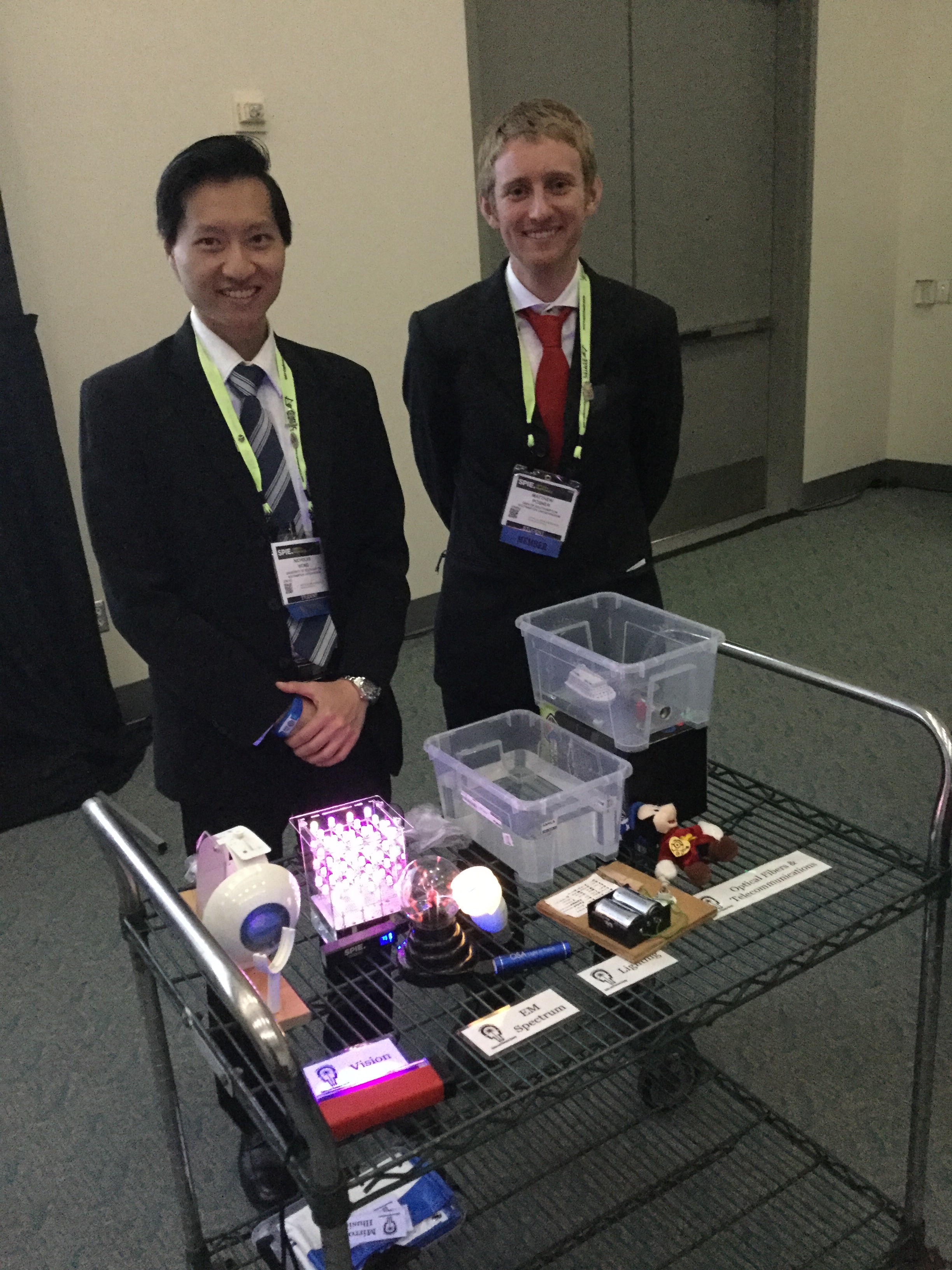
Suited to educate: Nicholas and I presenting our oortable hands-on optics experiments suite at the 2016 SPIE Optics + Photonics congress.
Suited to educate: Nicholas and I presenting our portable hands-on optics experiments suite at the 2016 SPIE Optics + Photonics congress.

IYL 2015 had a global reach and the global impact will also, no doubt, be huge. I will be going back to UNESCO next month to hear the report on the year.  It’s humbling that I played a part in this. I presented my hard work on the world stage at an international conference, people will read about this in a journal article, and I was filmed in front of a live audience on Facebook! Over 400 people have tuned into my talk, and those dearest to me, my girlfriend, sister, parents and family, were able to watch me present; that means the world to me.

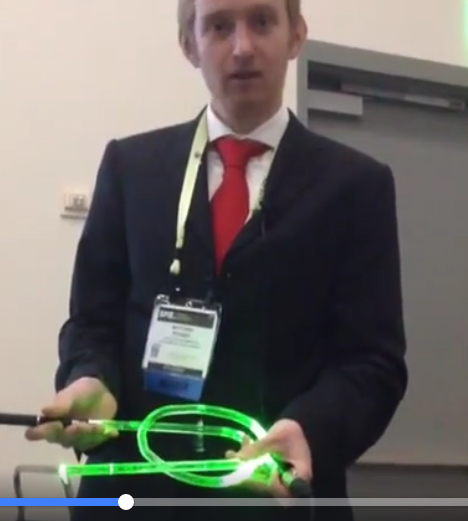
Demonstrating live how light can be guided through fibres of plastic by total internal reflection.
Demonstrating live how light can be guided through fibres of plastic by total internal reflection. Watch the full video here, courtesy of Dirk Fabian.


Matthew Posner Engaging with research, News Sep 5, 2016 2 Minutes

Hands-on optics

This Tuesday I visited the University of California, Berkeley. I had an excellent afternoon running an outreach workshop with the kit that I am touring.

With a group of 8 graduate students we explored 3 different themes of photonics, i.e. the science of light (photons). We used hands-on experiments to experience scientific phenomena on mirrors & reflections, the electromagnetic spectrum and telecommunications. Easier possibly shown in video.

Mirrors can be made to create illusions. The Secret Savings box is not magic. The floating ball is actually half a ball stuck on a diagonal mirror. The other half of the ball is a mirror image. The coin disappears behind the mirror when dropped in the top of the box.
White light isn't white. Right? We see it in rainbows, where sun light can be split into red, orange, yellow, green, blue, indigo, violet, ... This is the visible light of the electromagnetic spectrum. 
This plastic sheet is a diffraction grating, a rainbow maker. The plastic has thousands of lines engraved in it, a grating. The grating splits the different colours of the light by changing the direction of travel of each different colour. Gratings can be used to filter light, reflect it, block it, or make it change direction.
Light travels in a straight line, but it can be made to bend and change directions in materials such as glass or plastic. This effect is called total internal reflection and is the fundamental principle of operation of fibre optics. 
Fibre optics are strands of glass that physically connect the world to carry messages and information, in the form of light, and are the skeleton of the internet.

I hope you get the feeling that these are very hands-on demos!

One important point was raised during the workshop. It remains a challenge to explain the scientific intricacies to a public that is not familiar with the underlying science and applications. That is where the practical experiments come in handy, as experiencing these effects can lead to questions and richer engagement. I, the researcher, can inform and help my audience form an opinion on the subject matter and broaden their horizon.

I am very grateful to Stephan, Joe and Mimi from the University of Southampton’s ILIAD team for the help in making these Vine clips and setting up this Tumblr page with more examples of hands-on optics experiments.

Thank you again to the UC Berkeley Photobears Society for the warm welcome and hospitality.

Comments open for discussion.

Matthew Posner Engaging with research, News Leave a comment Aug 25, 2016 2 Minutes

Peer learning at Stanford

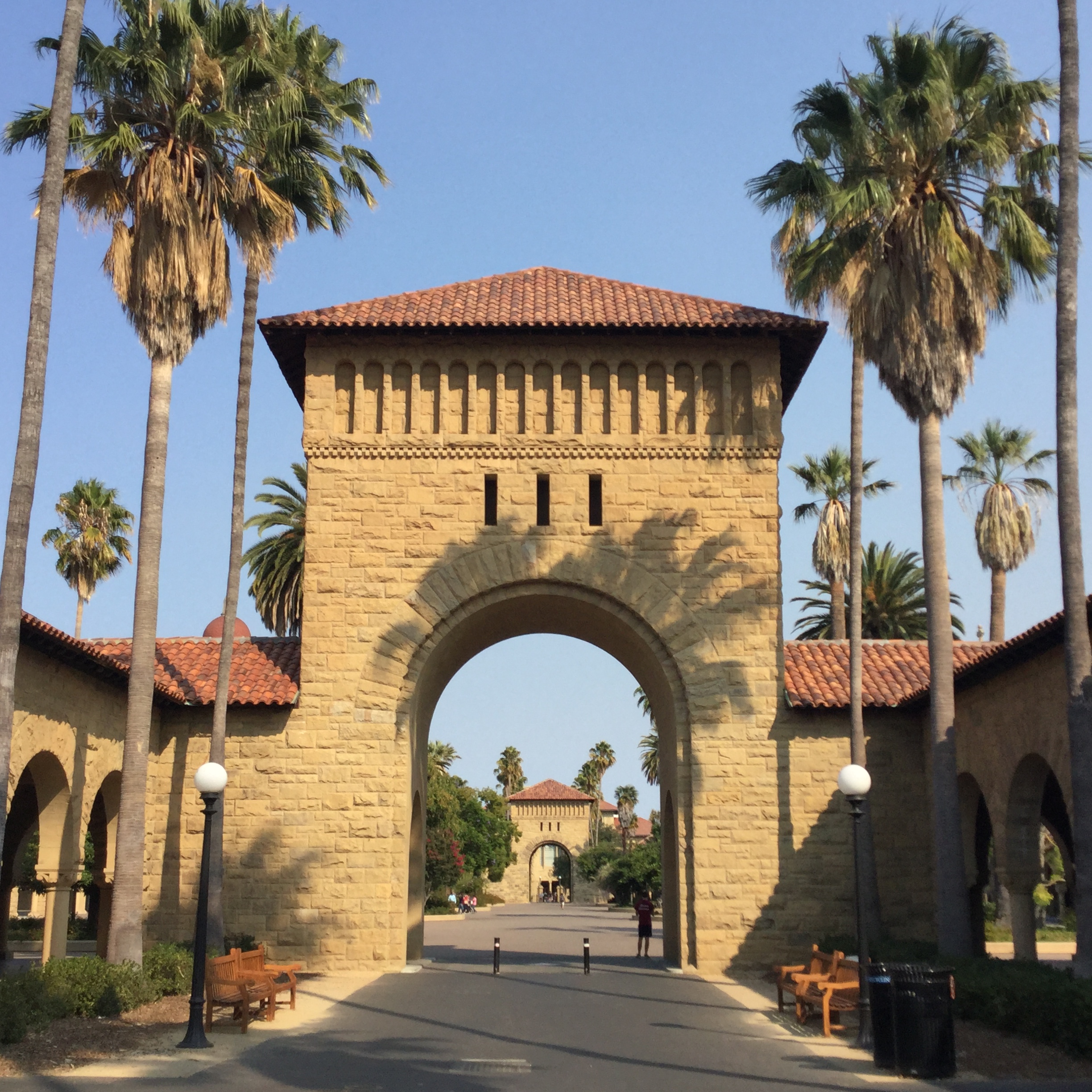
On Monday 22nd August I visited Stanford University. It’s an impressive campus. I loved the architecture, I really enjoyed there being palm trees, and the university has a great free shuttle bus service to transport visitors all around it.

Welcome to Stanford University, CA, USA.

I met with members from Stanford’s Optical Society. I presented examples from the activities that I have been running with the University of Southampton’s Optics and Photonics society and I had the opportunity to demonstrate the portable outreach workshop that I am touring. There was a lot of interest in the optics and telecommunications classes for school pupils that I and fellow PhD students have developed in Southampton; it would be amazing if these classes could be reproduced outside of the UK!

Portable outreach in a box

The presentation was really a 2-way discussion and I learnt a lot about their society. They have an impressive exec team, with a huge number of officers engaged in running their activities, be it social, charity, outreach, education or academic.

I found out about some of the original initiatives they have put into place to enrich the student experience of their members. Here are a few that inspired me, and that I hope can inspire others!

  • Technical skills workshop. Think of something that you might want to use on a daily basis, but don’t know where to start. It can be a software package (Blender), a programming language (Python), a document preparation tool (LaTeX), etc. Next, find students or academics within the department or the wider university who use these skills on a daily basis. Ask them if they would like to run a 3-4 hour workshop, then book a conference room, throw in some refreshments and there you have it, an educational activity for your peers and colleagues at the workplace.
  • Jointly run socials with other departments. The aim is to bring together researcher working with optics, such as photonics scientists with researchers in microscopy for biology applications. The key is to select your audience, and pitch it correctly.
  • Student weekend retreats. This is great. Organise a weekend with lectures from academics, sponsored by companies in the industry (to make it affordable on a student budget!), and invite students, researchers and industry professionals to network and socialise in a friendly environment.
  • Laser harps, as seen on Youtube. Looks amazing, I really want one!

I went to give a presentation, but at the end of the day I learnt a lot; I wish that these ideas will provide long-lasting inspiration to myself and others taking on voluntary roles in student societies. Thanks again to the Stanford Optical Society team for the warm welcome, I had a wonderful afternoon.

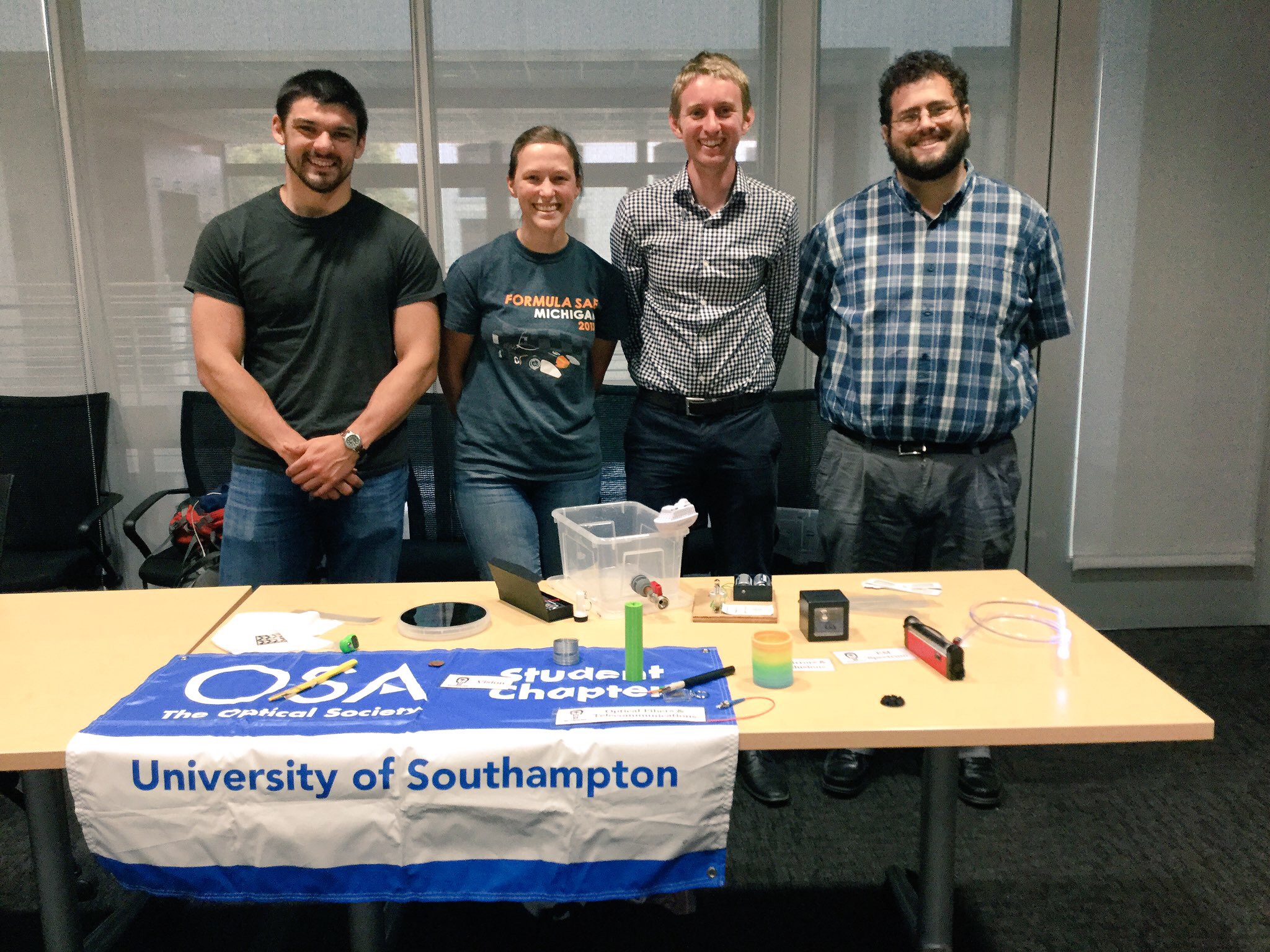
The Stanford Optical Society Exec and I (second from right)
The Stanford Optical Society executive team and I (second from right)
Matthew Posner Engaging with research, News Aug 23, 2016 2 Minutes

Visites à Montréal

When in Montreal…

Parlons français! // French spoken here!

À Montréal c’est pratique d’être bilingue! Je passe la semaine chez Laurie, une très chère amie de mes années collégiennes et lycéennes en France. C’ést génial de passer du temps avec elle à découvrir la ville et rencontrer ses amis. Par le plus grand hasard Max, un ami d’enfance, habite à Montreal aussi!

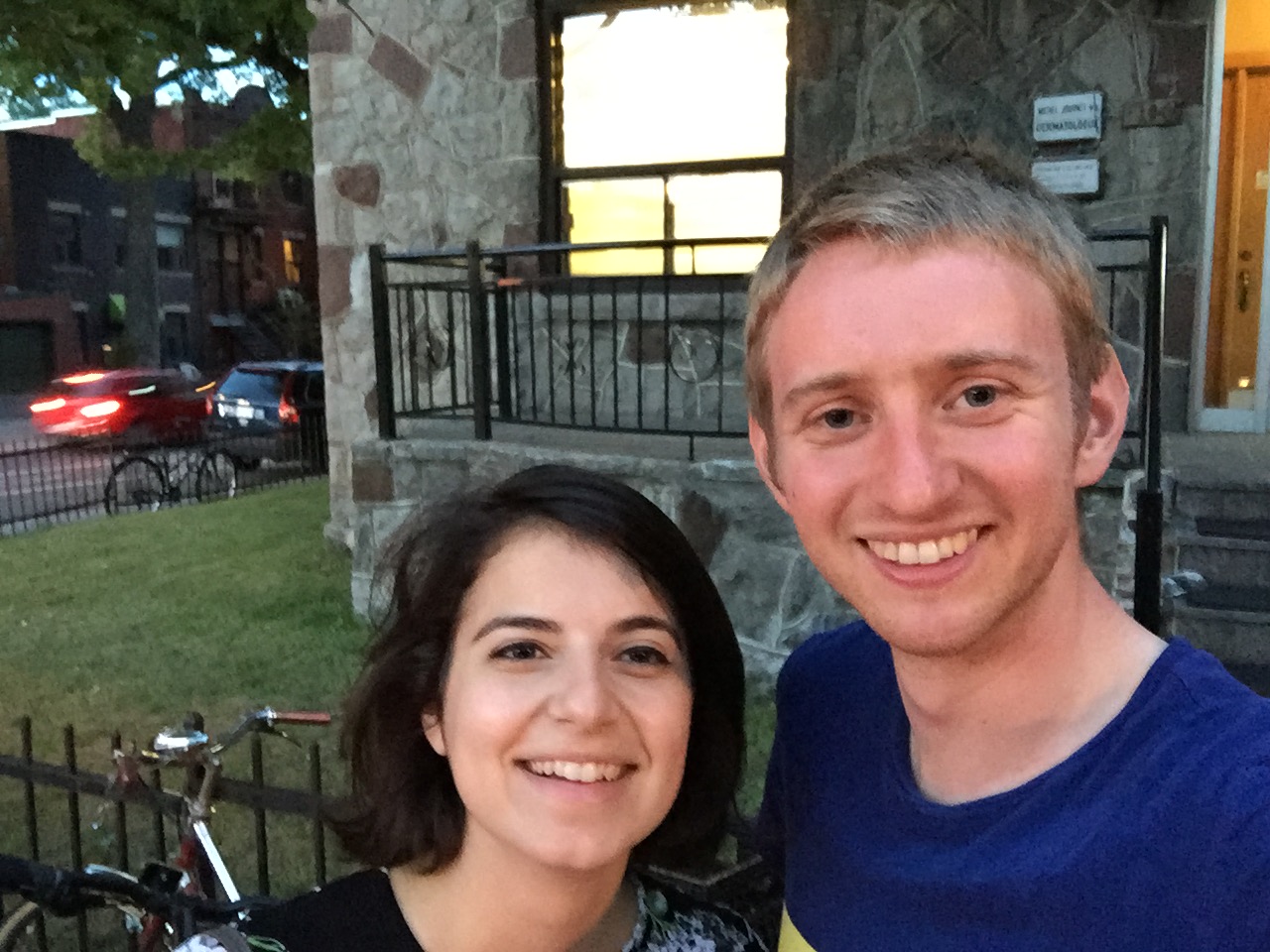
#montrealselfies
#montrealselfies

Je profite d’être en ville pour continuer mon tour des universités de l’Amérique du Nord. La population étudiante montréalaise est énorme, avec pas moins de 9 universités à travers la ville. Ça me permet donc de visiter la ville en allant d’un campus à un autre, et j’ai la chance de pouvoir me déplacer avec un vélo emprunté à une des collocs de Laurie.

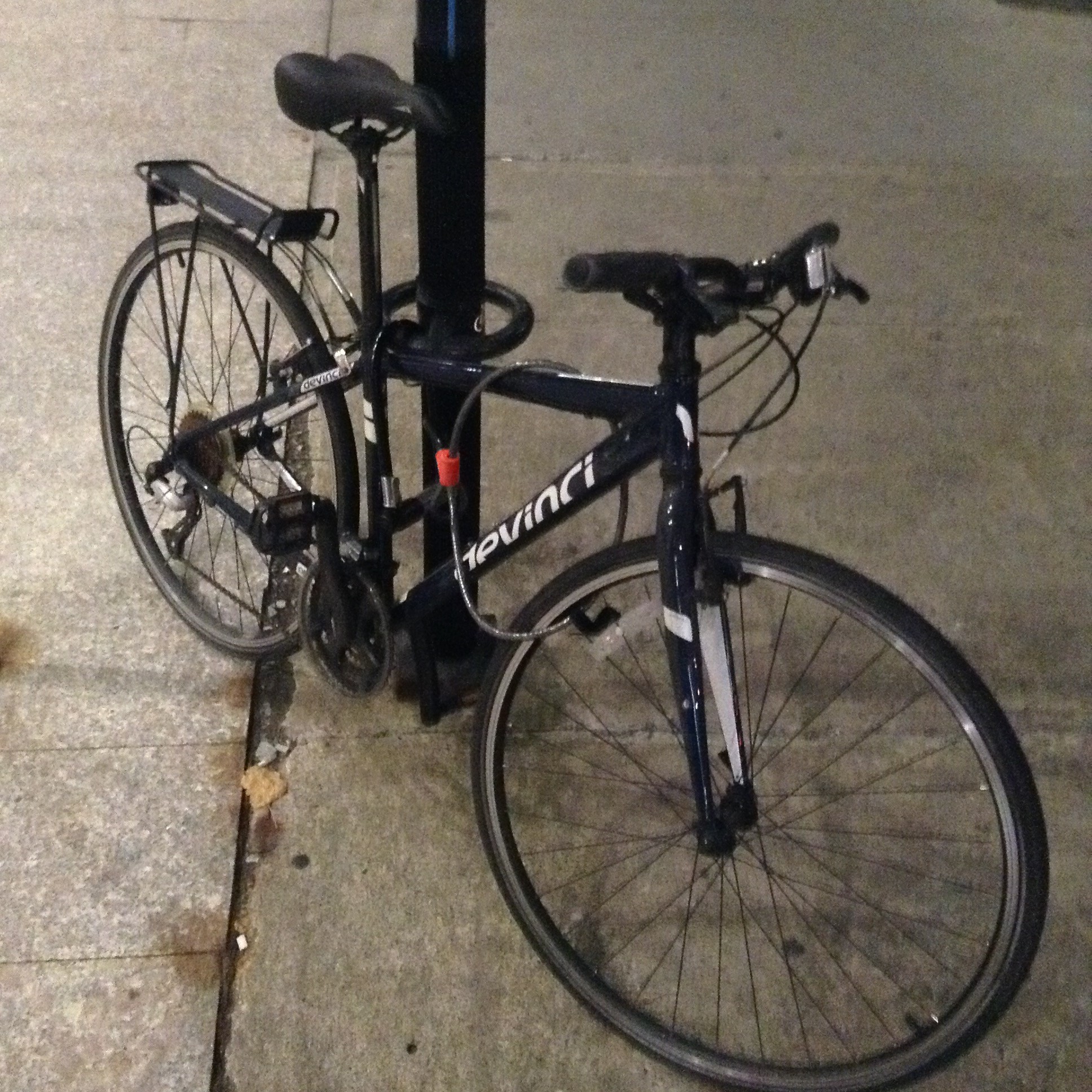
My bike for my week in Montreal.
En vélo à Montreal.

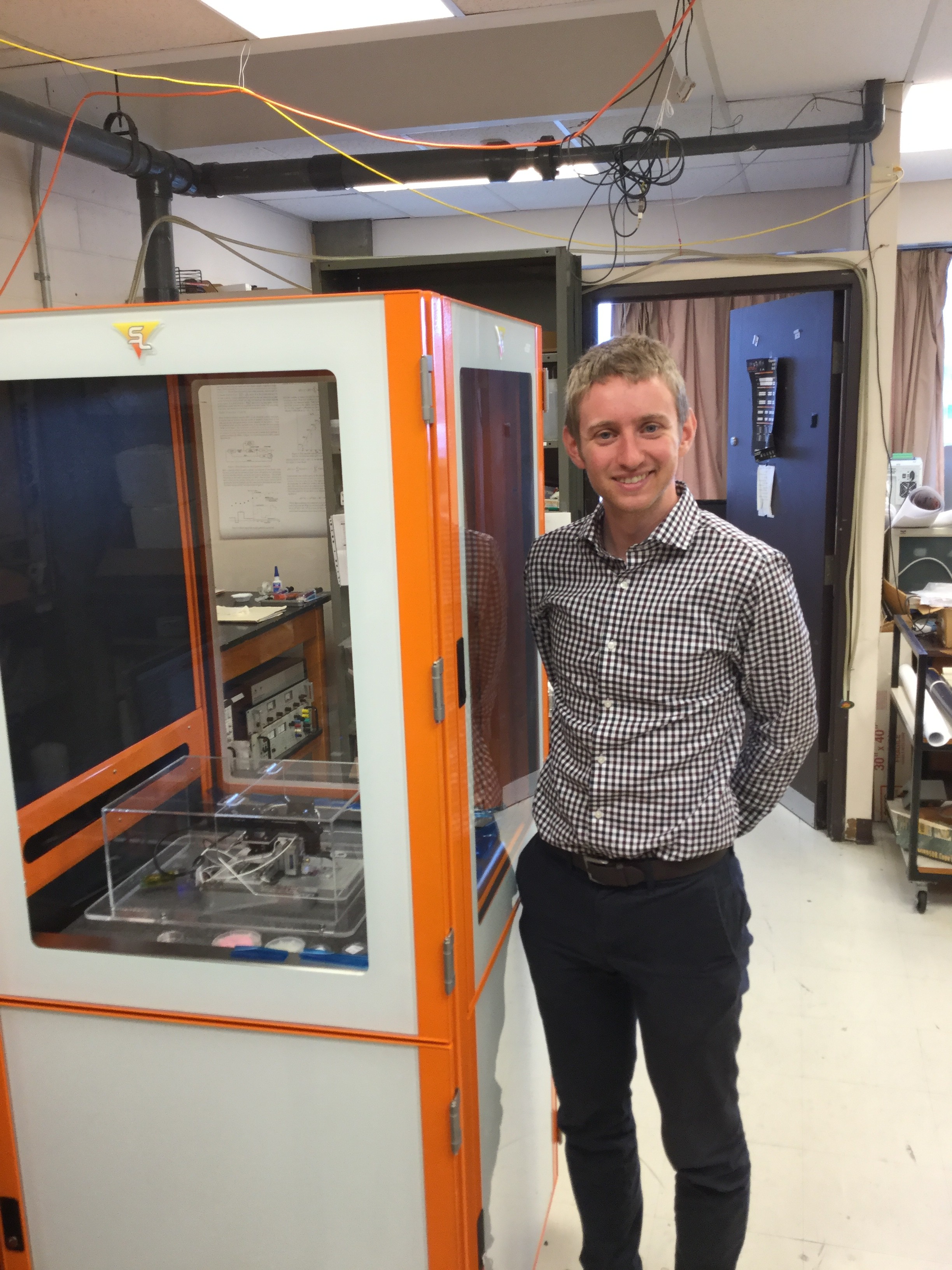
J’ai donc commencé par une visite à McGill, une université plutôt anglophone. Lors de ma conférence à Vancouver j’ai rencontré un chercheur, Sasa Ristic, et il m’a invité à visiter son labo lors de mon passage en ville. Il travaille avec un outil pour faire de la nanolithographie, c’est à dire l’écriture de formes avec des tailles à l’échelle du nanomètre, soit 1,000 à 100,000 fois plus petites que l’épaisseur d’un de nos cheveux.

Pour quoi faire? Les transistors, par exemple, qui font fonctionner nos téléphones et nos ordinateurs se miniaturisent depuis plus de 50 ans, et aujourd’hui leur taille est à l’échelle du nanomètre. Des outils d’ingénierie ont été développés pour créer ces composants nanométriques, et en ce faisant les chercheurs ont su identifier d’autres opportunités pour l’utilisation de ces machines de ‘nanofabrication’. Me voilà donc en compagnie d’un outil dont on commence à rechercher comment l’employer pour des nouvelles techniques de fabrication.

En compagnie du NanoFrazor de SwissLitho AG à McGill.

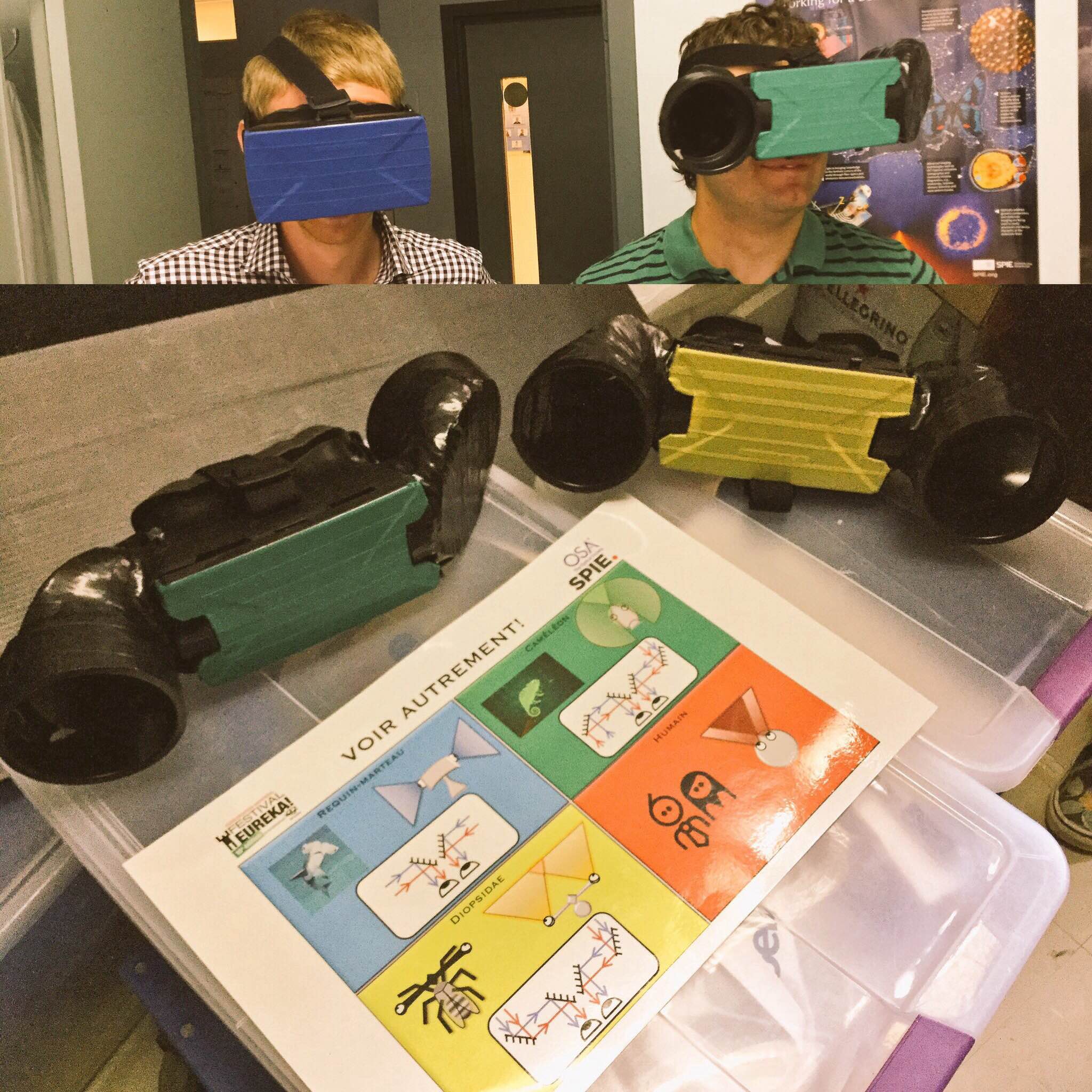
Je suis passé visité l’Ecole Polytechnique de Montreal pour rencontrer le comité de leur association étudiante OSA et SPIE. C’est très inspirant de voir ce que d’autres groupes autour du monde mettent en œuvre pour leur membre. Ils organisent des séminaires sur comment rédiger des articles scientifiques, des concours de culture générale entre étudiants et professeurs, et participent à des festivals de science pour le grand public, tels que le festival Eurêka qui se déroule au Vieux Port de Montreal. Me voici avec Jean-Sébastien en train de de voir le monde à travers les yeux de différents animaux!

Comment voir le monde autrement, avec des casques et des mirroirs.

Je fus particulièrement impressionné d’apprendre que les associations étudiantes en photoniques dans l’est du Canada se retrouvent tous les ans pour discuter et organiser des rassemblements internationaux d’étudiants pour une conférence.

Merci à tous pour l’accueil chaleureux lors de mon séjour en ville!

Matthew Posner Engaging with research, News, Reunions, Travel Aug 19, 2016 2 Minutes

Photonics research and student life at the University of Toronto

On Thursday 11th August I visited the University of Toronto. Their SPIE student chapter hosted me for the day, and I had the chance to visit Professor Peter Herman’s research labs, and exchange ideas with researchers and students whom I met. This article is going to look quite academic, with a number of references to conference papers that I have published; they are numbered in square brackets – like this: [1], [2], etc. – and I promised I’d send them through.

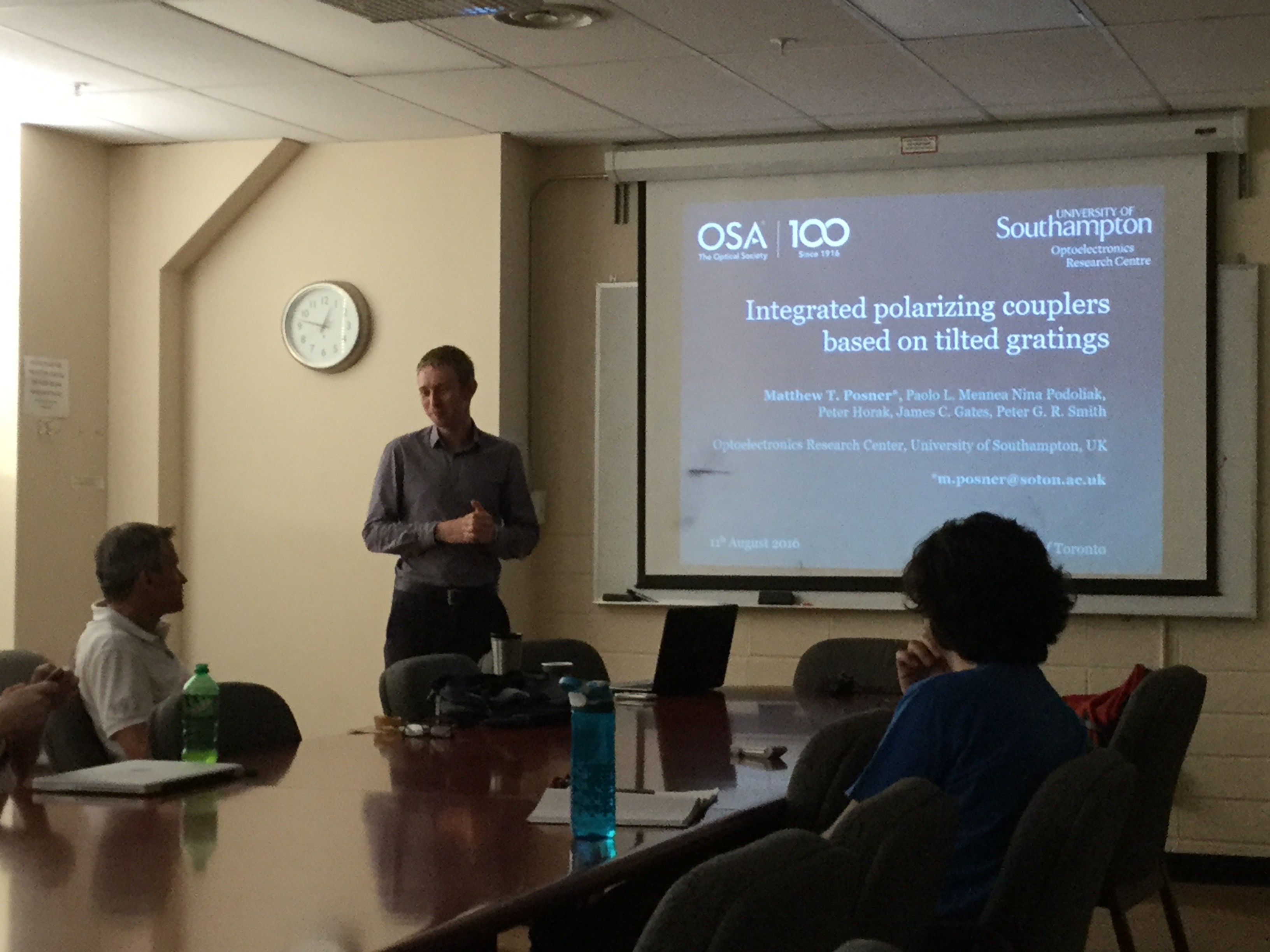
I came to Toronto prepared with a well-rehearsed research talk based on a presentation I gave last month in Vancouver, BC [1]. The researchers in Toronto employ very similar fabrication techniques to the ones I have been working on in Southampton, so I figured that there would be some learned opinions and tough questions. They didn’t disappoint. I had to do some convincing that the integrated photonics devices that I presented last year at a conference in Munich worked the way we expected them to [2]. I was thrilled that my talk turned into a discussion, with regular interruptions to find out more on various topics. It’s given me ideas to research, reflect on and explore when I return from my travels.

I had the opportunity to present my work on integrated photonics devices to researchers from the University of Toronto.

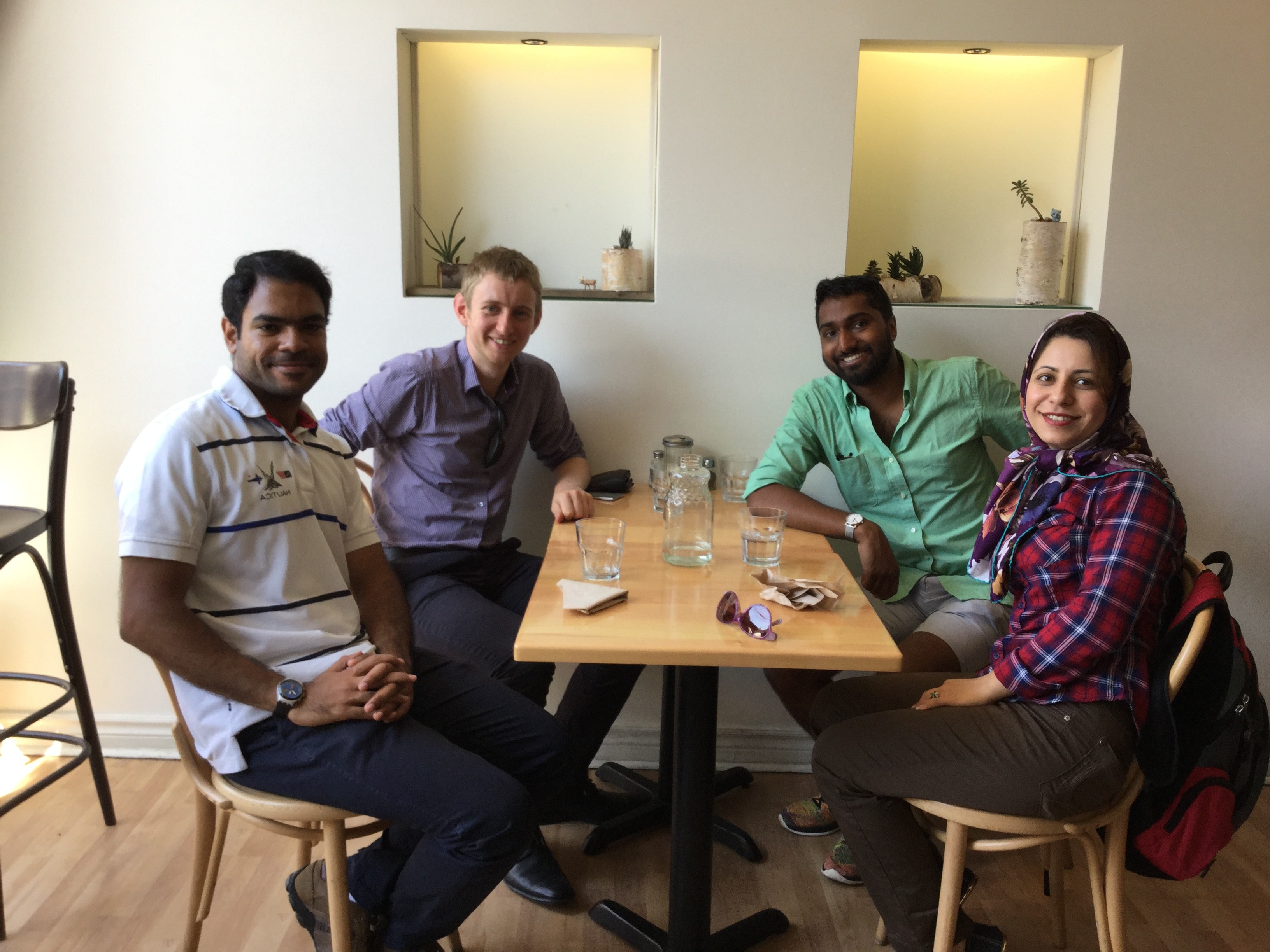
I met with Kevin, Zeinab and Ahmed, all graduate students and officers of the University of Toronto’s SPIE student chapter. We shared our experiences of running our respective societies. I was inspired by the professional development activities that they organised and took part in, events like international student conferences, and talks from world-leading academics, to name a few. After that, I presented to them the outreach kit that I am touring, and told them more about our Lightwave Roadshow that I have been leading/overseeing for the past 3 years in Southampton [3].

Lunch with Kevin, Zeinab and Ahmed (starting at the back right, and going clockwise!) from the University of Toronto SPIE student chapter.

Thank you for the coffee, lunch, lab visits and the tour of the campus, it was an excellent day!

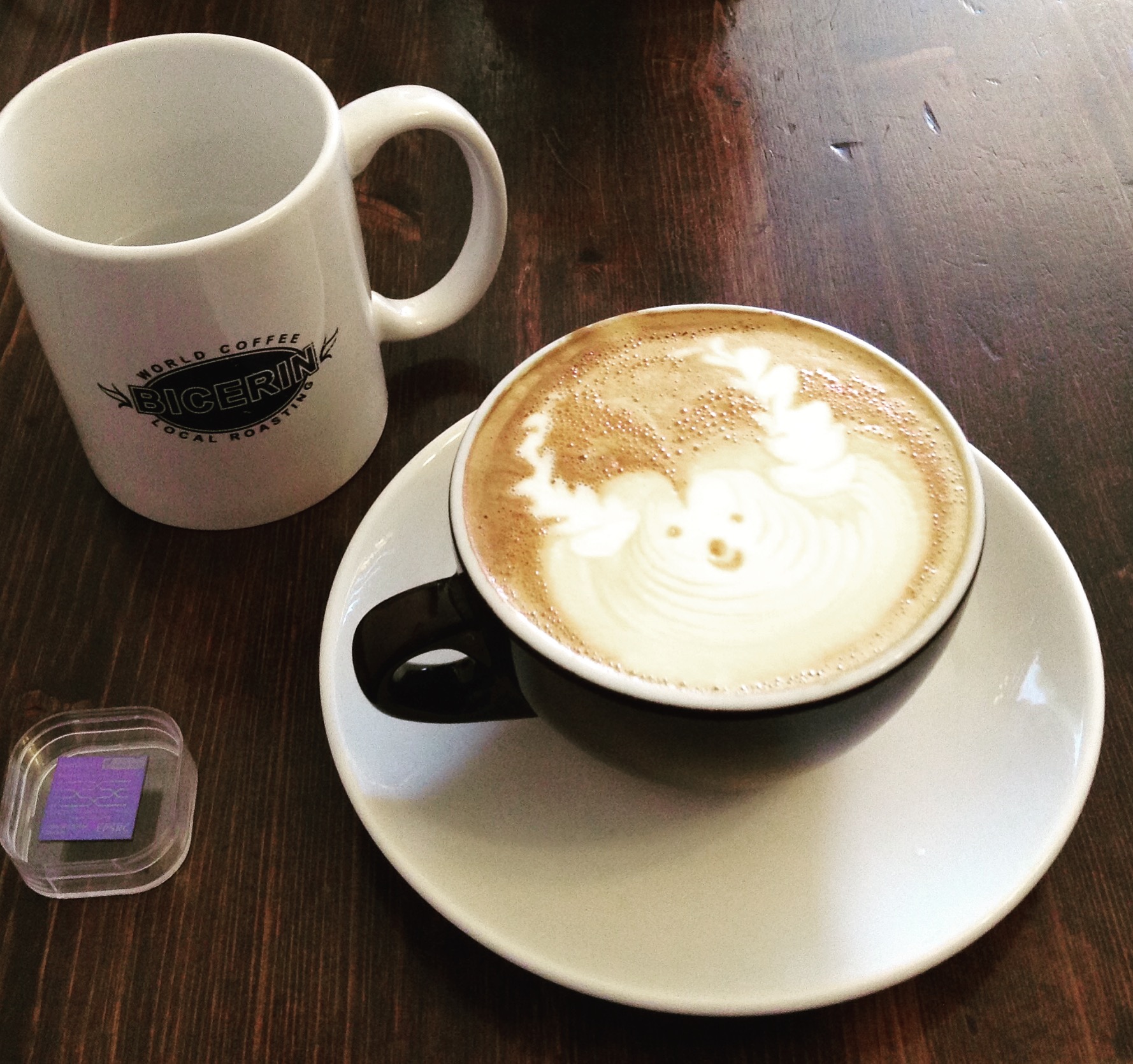
Coffee and research
Coffee and research

References

[1] M. Posner, P. L. Mennea, N. Podoliak, P. Horak, J. C. Gates, and P. G. Smith, “Integrated polarizing coupler based on tilted gratings,” in Advanced Photonics 2016 (IPR, NOMA, Sensors, Networks, SPPCom, SOF), OSA technical Digest (online) (Optical Society of America, 2016), paper IW3B.3; video and talk online (OSA members only)

[2] M. T. Posner, P. L. Mennea, N. Podoliak, P. Horak, J. C. Gates, and P. G. Smith, “45° tilted gratings for silica-based integrated polarizers,” in 2015 European Conference on Lasers and Electro-Optics – European Quantum Electronics Conference, (Optical Society of America, 2015), paper CE_10_5

[3] N. H. L. Wong, M. T. Posner, P. V. John, “The Lightwave programme and roadshow: an overview and update,”, Proc. SPIE 9793, Education and Training in Optics and Photonics: ETOP 2015, 97932V (8 October 2015); doi:10.1117/12.2223239 

Matthew Posner Engaging with research, News Aug 17, 2016 2 Minutes

Boulder wrap-up

Boulder has been great. I hope you saw the pictures and my post about my visit to NIST.

Last Thursday I had a mini industry day. I started the day with coffee with David Giltner, product manager at Zolo technologies, and who I, and the University of Southampton Optics and Photonics Society, have invited to Southampton to give a talk to try and answer the question “Can a scientist find a rewarding career in industry?” That’ll be on September 13th, stay tuned!

I followed up with a visit to Vescent Photonics in Golden. They, amongst other things, help take scientific ideas and make them into products. They are doing some really exciting work on packaging lasers, and I talked about some of the work that fellow PhD student Stephen Lynch is working on.

On Friday I visited the University of Colorado Boulder. Their OSA-SPIE chapter showed me around their labs. They are working on some really cool stuff, including portable LIDAR systems for remote sensing in water (see Rory holding his portable system below), optical filters (think light) that you can tune with acoustic waves (think sound) for spectroscopy imaging, and silicon photonics for light-based computing. It was great to meet the chapter, who organised for me to present my research. I also caught up on Monday to present the outreach kit I am touring.

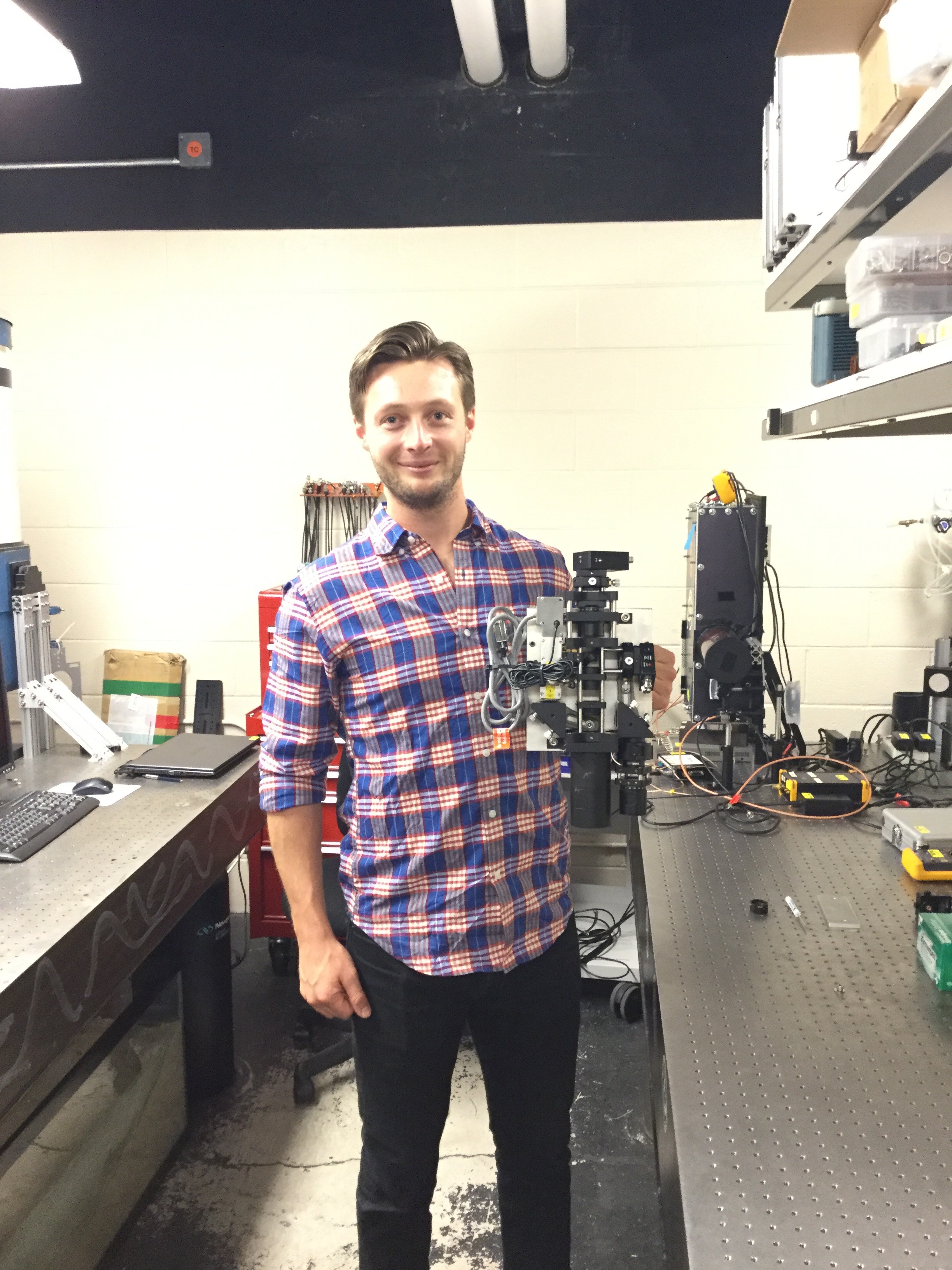
Rory Barton-Grimley with his single photon LIDAR.

Scientists and engineers love acronyms. Who can guess what ARSNL and SQUIDS stand for?

Here they are:

ARSNL: Active remote sensing lab
SQUIDS: Superconducting quantum interference devices

It’s not all people though. What’s kept me from writing here has been writing up two papers that I will be presenting at the SPIE Optics Education and Outreach conference that I’m attending in San Diego at the end of the month. Last week was spent writing in every possible break and 12+ hours day at the weekend. Thankfully I have a brilliant group of co-authors to review my words, and it was all submitted by Monday.

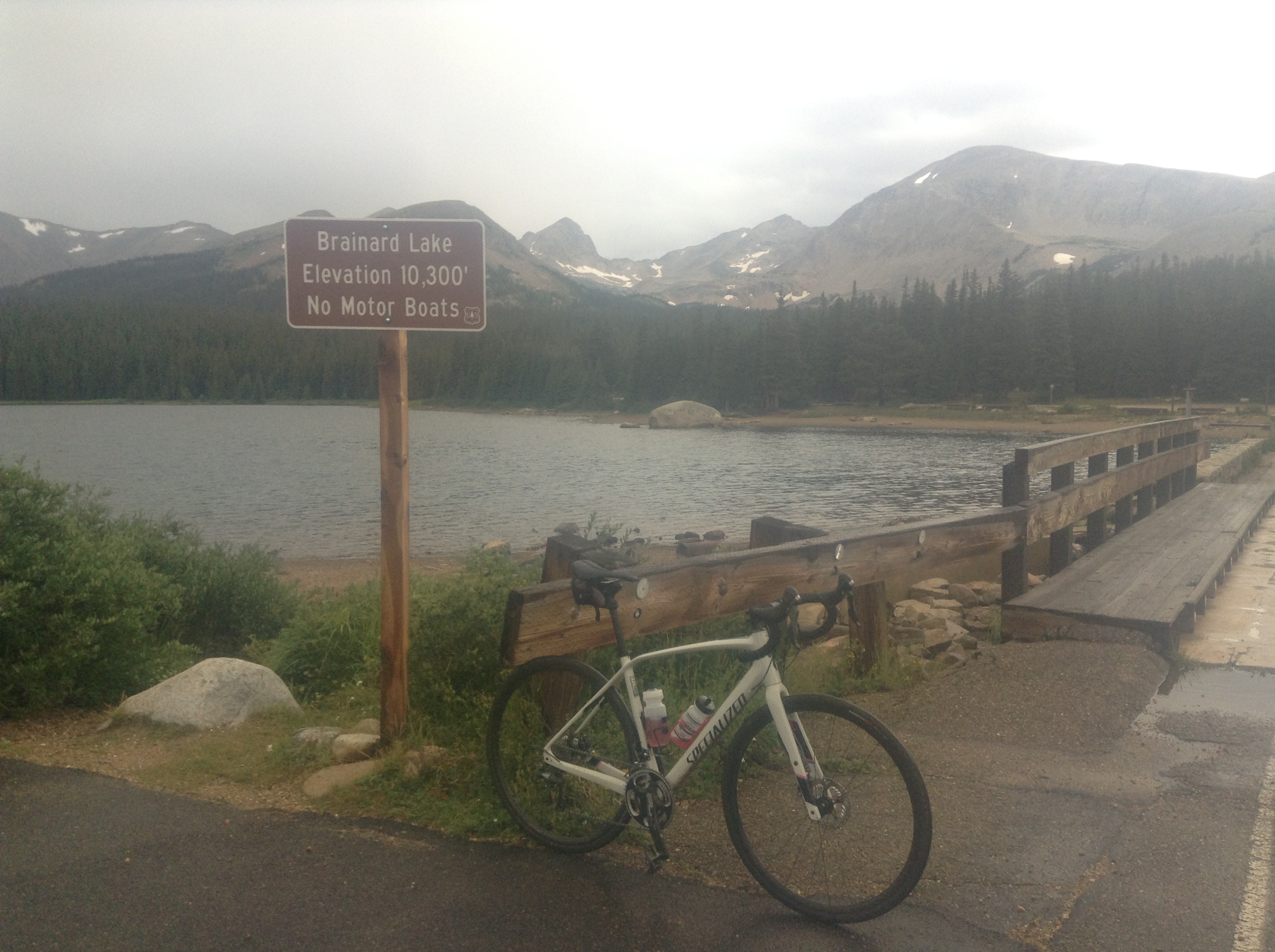
I felt like I deserved a break on my last day in town and headed out for a bike ride. It was a glorious day, pushing my body and bike up over the top of mountains. Super happy to have ridden to above the 3,000 metre mark. The descent was totally worth it though, as was the beer and pizza after!

Brainard lake, on a bike. My first ride ever over 3,000 metres!

Next up is Toronto. Hope you can tune in. You can now subscribe to updates to not miss any of my posts or gallery updates.

Thanks again for following!

Matthew Posner Cycling, Engaging with research, News, Reunions, Travel Aug 11, 2016 2 Minutes

Posts navigation

Older Posts
Create a free website or blog at WordPress.com.
International Photonics and Outreach
Blog at WordPress.com.
Privacy & Cookies: This site uses cookies. By continuing to use this website, you agree to their use.
To find out more, including how to control cookies, see here: Cookie Policy
  • Subscribe Subscribed
    • International Photonics and Outreach
    • Already have a WordPress.com account? Log in now.
    • International Photonics and Outreach
    • Subscribe Subscribed
    • Sign up
    • Log in
    • Report this content
    • View site in Reader
    • Manage subscriptions
    • Collapse this bar

Loading Comments...

    Design a site like this with WordPress.com
    Get started