Digital Firsts

Since I wrote about my first international online workshop experience at the start of the summer, I can report back, unsurprisingly perhaps, to say that a majority of my meetings have shifted online. It’s been a blur of Google Meet, Zoom, Teams, Webex, Remo and other online spaces used to connect with family, friends and colleagues. In July, Shashwath Bharadwaj hosted me on the SPIE Facebook Career Lab for a week long residency to discuss these online meeting experiences. I ran a survey with about 40 of the group Members, and found that amongst respondents aged 25-35, most were meeting online for work at least 2-3 times a week. This time last year for me, it was probably closer to 2-3 per month for work!

Repurposing furniture and space for my home online meeting setup

The inspiration for this blog has shifted. The reflex for reporting a trip and travel, which physically took me out of context, has evaporated. I had planned to write earlier about my August travel to Sunny San Diego and the paper that I was going to be presenting at the SPIE Optics Education and Outreach conference, but that went digital too. The paper was published and presented, virtually of course, as part of the SPIE Digital Forum. This was a first for me, which involved a combination of writing a paper, adapting it to present on a Slack channel, pre-recording a talk following expert advice (see Jean-Luc Doumont’s SPIE webinar online), setting up my home space to present my work. A shift into a new normal!

My first paper presentation on Slack. The full text is available via the SPIE Digital Library.

The reception of the paper has been pleasing. My SPIE Slack channel had almost 70 people following my experimentation with live “Slack chats“, to translate the paper to this text-chat-platform. As a follow-up, I was invited by Excelitas‘ global training and development program to share this work with colleagues in the organisation. This turned out to be my largest live technical audience to date, with almost 100 people from 3 continents on the web. People have been interested in discussing how skills can be transferred between teaching and work environments, lessons learnt from internship programs, and the need for programs for training in industry with models for inclusivity and equity at their core. I appreciated the sense of appreciation from my colleagues and the wider community.

Zoom Selfie of the 2020 Students and Early Career Professionals Committee, part of the SPIE governance structure.

The need to connect with the professional community has accompanied me throughout the summer. I have had the pleasure to e-meet many new people through digital networking. The need to learn new tools to make new connections were fast tracked by my responsibilities in other volunteering roles! My governance roles with the SPIE took a digital turn, and opened new and wonderful ways to connect and progress on this aspect of my volunteer work for students, early career professionals and education. Closer to home in Montréal, the next big event ahead is the 4th Montreal Photonics Networking Event. This is happening on a screen near you, on Friday 23rd October! If you have read this far, you are invited to register!

Coming soon to a screen near you : the 4th Montreal Photonics Networking Event. Registration is open!

It’s certainly an exciting time to be learning, collaborating and making progress in the fields. I wish to sign off with a note of appreciation to the technologists that have permitted an accelerated digital transition to this new online reality. In my research days, I taught school students a class called Communicating with Light – developed independently from Prof. Polina Bayvel’s excellent Clifford Patterson lecture. We explored how the science and technology of photons and electroncs, photonics and electronics respectively, were used in getting our internet to function. The internet is made possible by the physical infrastructure of fibre optics cables laid around a world and improvement to computer chips to make sense of the digital information leaping across continents. The reality that we’ve glided into a new scale of this digital age is testimony to how important the fundamental sciences and applied technology have been in helping this happen. As I mark this post in the Canadian Thanksgiving weekend, I reflect on that there is a lot to be grateful, not least your attention!

Optoelectronics research for primary school students : bringing the internet to you, with light and electricity.

The 2020 International SPAD Sensor Workshop

Last week I attended the 2020 International SPAD Sensor Workshop. This was an international meeting that did not involve me travelling around the world to Edinburgh, Scotland; indeed, the entire workshop was held virtually owing to the Covid-19 crisis.

The new “normal” for meetings

Single-photon avalanche diodes (SPAD) are a mature photonics technology. Today, there is a large interest from the private sector, reflected by a majority (55%) of attendees coming from the industry and many student research projects conducted in collaboration with advanced R&D departments. The workshop covered a broad range of topics, from current technology trends for manufacturing and testing devices, as well as applications and systems studies.

Current developments are being driven by a number of biomedical imaging applications, such as PET and CT scanners, through to applications in the many segments of the commercial LIDAR market.  These bigger markets are bringing larger manufacturing centres closer to developing this technology, such as ST, Canon and Panasonic. This was all the more evident by the overwhelming number of contributions in talks, sponsors, and funded research students linked to high-volume CMOS manufacturing .

A significant amount of progress has been made since the seminal review on the subject from 2008 (via IEEE Explore) and early patents from ST on CMOS based SPAD (via Google Patents). Many of the talks explored the scaling of the technology using advanced CMOS manufacturing techniques for the production of SPAD arrays. Highlights to me, from the applied technology aspect, were the incorporation of test structures to measure the properties of these sensitive devices (more to follow this year from Alexander Zimmer at Xfab) and the demonstration of megapixel SPAD sensors (via OSA Optica). There were also many novel architectures for custom devices, to improve high-efficiency detector arrays in silicon technologies (via IPT), adapting material processing to achieve more efficient designs (delta-doping via SPIE DL) and going beyond silicon using germanium (via Nature Communications).

Live from the conference at home in Canada

The online format was original. The organising committee proposed an online hybrid platform to ensure presentations and content were accessible throughout the week. Live presentations were done on Blackboard Collaborate and streamed live at British Standard Time. This made for a very early start on day #1 : 4 am ET to be precise! The presentations were recorded and made available on a Microsoft Teams channel afterwards. This channel was open to all attendees to chat, and pre/re-view posters and talks. The platform also hosted two live poster sessions, with small breakout rooms to meet and discuss research in a more informal setting. The organisers even scheduled coffee breaks. It took some organising to connect with people virtually, but the closed group guaranteed that interaction was genuine. The serendipitous meetings with attendees, presenters, and organisers at events was missed compared to the real-life experience. Kudos to the 20-strong person team operating in the background that contributed to this event running so smoothly!

Generous Networking

I’m happy to be back on the blog to share the news about organising an event to bring together students across Montréal to discuss experiences, enhance research synergies and connect the industry with the dynamic pool of talent that exists in town. I was part of the organising committee for the 3rd Montréal Photonics Networking Event. The event was held on December 3rd 2019 in conjunction with the STARaCOM Winter School at McGill University’s New Residence Hall Conference Centre. There were almost 100 attendees, with 70 students, 18 of which presented research posters, and 20 professionals, including 10 judges from industry and academia.

Committee Slide
The organising Committee of the 3rd Montréal Photonics Networking Event, with representatives from academia, industry and students from all 6 Montréal Universities with photonics research.

The event was brought together through our shared network. Everyone worked hard to get the word out to the students and professionals in town. We hosted two amazing speakers, Prof. Caroline Boudoux and Dr. Sebastien Blais-Ouellette, who shared their perspectives on transforming photonics technologies into enterprises. We obtained support from our partners to get this event off the ground and celebrate the quality of the research in Montréal, so I have to extend a special thanks to our partners, SPIE, the International Society for Optics and Photonics, Excelitas Technologies, IEEE Montreal, Optonique and STARaCOM.

The dynamics in the organisation of this event reflect a form of Generous Networking, a concept that I borrowed from a generous networker and friend, Dr. Christina Willis. The idea is simple: 

Know what your connections need, and find ways to help them before asking for their help.

I have been fortunate that through the professional networking I developed during my years in academia I encountered many individuals who were generous in their time and advice to help me settle in a new town far from “home”. Being part of the global students networks of the OSA, SPIE and IEEE Photonics Society organisations has been a privilege and a career boost. I enjoyed having the chance to meet  the current student leaders across the universities in Montréal and be a part of the informal chapter meet-up at our event. Montréal is a cradle of talent to feed the 200+ companies in the greater Montréal recently identified by Optonique’s survey of the Quebec Photonics landscape.

img_20191203_142801830
Student leaders of the SPIE, OSA and IEEE Photonics Society professional organisations in Montréal.

In the year that I’ve been in Montreal, I have enjoyed discovering the city and its rich professional landscape for photonics. I am grateful to the generous networkers who have contributed to helping me to get to where I am today. Thank you for giving me the opportunity to connect the dots back through my involvement in the Montréal Photonics Community. It’s fun, collaborative and there is still a lot of progress potential: all of this helps me with getting up in the morning!

Save the date: the 4th annual event is coming back to Montréal on October 23rd 2020!

191203-171324-0980
See you in 2020 for the 4th Montréal Photonics Networking Event! Photo credit Owen Egan

Photonics West 2019: courses, networking and visiting Silicon Valley

I’m back in San Francisco for Photonics West. A lot has changed since last time: I’m married, I graduated from my Ph.D., my wife and I moved to Canada, and I started a job as a process scientist at Excelitas Technologies Canada.

Through all of this I’ve worked to keep up my engagement with the optics and photonics professionals societies, and in particular with the SPIE, the international society for optics and photonics. I’ve started a second term as member of the SPIE Education committee and the Student and Early Career Professional Ad Hoc Committee. My attendance to Photonics West is supported by the SPIE and I’m grateful for the opportunity to keep contributing to the society’s missions in Education and for young professionals.

As a recent addition to the semiconductor manufacturing workforce, the program of my week looks at lot different to being a Ph.D. or postdoctoral researcher. SPIE offers courses that are pertinent to my field of work, which my employers value. I will be attending the following courses to develop my knowledge of the technical semiconductor sector in photonics, as well as skills on project management and product development.

  1. Semiconductor Photonic Device Fundamentals
  2. How to Develop Profitable Technology Products
  3. The Seven Habits of Highly Effective Project Managers

As always, a conference is a meeting and an excellent place for networking, learning about developments in the field of photonics, and finding people to collaborate on new and exciting projects. The first place you’ll be able to find me is on Sunday night from 9 pm at 21st Amendment Brewery for the SPIE Careers Lab meetup – see the Facebook event for more information. I’ll be around the conference at the technical sessions, the trade show and the special events. I’m also excited to be visiting Silicon Valley later in the week. More on that later. Follow this space for more details and if you’re in town, get in touch!

Career Lab Meetup.PNG

SPIE Optics + Photonics 2018

I’ll be attending the 2018 SPIE Optics + Photonics congress this coming week. This will be my second time in San Diego in two years and I’m excited to be returning to what has been one of my favorite meetings on the photonics conference circuit.  If you are attending and I haven’t spoken to you yet, then please get in touch through the contact page or LinkedIn! See below for an abridged schedule of talks, training and meetings as well so that you can get an idea of where to find me!

I am particularly excited about all of the Optics Educators and Outreach aspects of this congress. My week is filled with exciting outreach and education activities. I will be judging at the Outreach Olympics on Sunday (where I myself presented two years ago!), presenting alongside expert Photonics Educators Mike McKee and Nancy Magnani (there is still time to register at this link!). I will also be attending the Fifth Optics Education and Outreach Conference. I will be presenting two papers on outreach and public engagement activities that I did when I was previously in Southampton’s Optical Engineering and Quantum Photonics group. They are on Wednesday, and I hope to see you there!

Hope to see you there!


Where is Matt in San Diego? 

Saturday 18th August

  • Time off, visiting Torrey Pines and Mt Soledad.
  • (Thoughts will all attending the Student Leadership Conference, an excellent event that left its’ mark on me a couple of years ago!)

Sunday 19th August

  • Optics Outreach Games, Marriott Marquis, Marina Ballrom E, 19:30-21:30.

Monday 20th August

  • Training the trainer in OPTIKS: Outreach for professionals who teach in informal environments and K-12 schools.
  • Women in Optics Presentation and Reception, Marriott Marquis, Marina Ballroom F, 17:00-17:30

Tuesday 21st August


Wednesday 22nd August: Optics Education and Outreach V, all in Conv. Ctr. Room 28A.

  • Taking large optical quantum states out of the lab, 13:50-14:10
  • Taking quantum entanglement out of the lab, 17:20-17:40,
  • And don’t miss Callum’s talk on “Student-led outreach and public engagement activities at the University of Southampton to celebrate the inaugural International Day of Light”, 11:40-12:00


Lessons learnt in innovation

The EPSRC summer school was an applied approach to understanding the many different facets of innovation and entrepreneurship in photonics. The week featured Technologists who shared case studies and valuable insights into how a technology or a scientific principle could be developed into a business. To echo thoughts that I heard throughout the week, it’s not the tech that makes money, it’s the business model wrapped around it. There is not a recipe to for all and for this reason it was extremely insightful to get many perspectives from experts from in their early steps of entrepreneurship right through to the seasoned innovators.

Right to left: Prof. T. Baer, Prof. M. Dawson and Prof. C. Boudoux in conversation with moderator Prof. D. Reid during the panel discussion on innovation and entrepreneurship experiences.
Perspectives on innovation and entrepreneurship panel discussion with (right to left) Prof. T. Baer, Prof. M. Dawson and Prof. C. Boudoux in conversation with moderator Prof. D. Reid.

The school also consisted of courses in management and strategic planning techniques that can enable development and innovation in companies. Methods such as SCRUM , SWOT analysis and PESTEL, as well as technology screening techniques were introduced. These were put into practice throughout the week in an effort from the organisers to make the concepts as tangible as possible, which was very engaging and effective. A couple of lessons have stuck with me. First, complex information unrelated to the technology can be strategically selected to make greater impact in the workings of an organisation. Second, which resonated with me very well, values inform both the vision and the mission of a business organisation.

In conversation with Mike Reilly during SCRUM workshop session for the development of a business plan for our social enterprise.

The main deliverable of the week was a group project to develop a pitch for a start up for a product or service for the photonics industry. My team, Haggis Photonics (affectionately named after one of Scotland’s national delicacies), developed a pitch based on building automated components for the photonics industry using 3D printed technology. The business would place itself between the expensive equipment and the Makers market. We also identified a potential to use this product for the training of technician in vocational career paths, a subject close to my heart! We had the opportunity to pitch the idea to 3 serial entrepreneurs and business development experts. The exercise and feedback was very insightful into what is needed in the process of developing a business.

Final poster presentation of my research in integrated optics and Bragg gratings from the University of Southampton!
My final poster presentation on my research in integrated optics and Bragg gratings from the University of Southampton!

The week was very enjoyable, busy and packed full of educational and social activities. The social highlights for me were the traditional Scottish Ceidh, a very active evening of dancing, and the banquet dinner in the luxurious university Lower College Hall (see cover picture!). I also had the opportunity to present one of my last projects that I have conducted in Southampton as a result of research done during my PhD, which was a great opportunity to reflect on the work I had conducted in the past 4.5 years.  Thanks to the school I have gained a lot of insight into how innovation takes place in the tech sector. It has given me lots of pointers to look out for as I embark on the next stage of my career (announcement on job situation to follow!).

To sign off, I wish to extend a thank you to Prof. Derryck Reid and Kasia Sulima for the organisation of the summer school, Munadi Ahmad for the cover picture, and the local student organising team for a week packed of social activities. Thanks for tuning in. Bye for now.

Passion driven Innovation

The first days of the summer school have brought me some rich insight into the world of technological entrepreneurship. I am struck by the diversity of the scenarios that can be tackled by using photonics, from making intricate glass parts for watches with lasers, or using smart LCD tags in supermarkets and right to using 20-year of fibre optics and medical imaging research to enable the next generation of medical screening devices for point-of-care diagnostics. Photonics is not just enabling technology, it is causing whole business ecosystems to collide and is generating solutions that will transform the landscape where we live in ways only limited by our imagination.

“Venturing” is tough; indeed, etymologically speaking, a venture is the risk of loss. Resilience is a trait that transpires from the stories of the technologists that have been shared this week. Yet the positivity in enterprising is palpable, as is the excitement linked to rationally stepping out of one’s personal comfort zone. Raw passion and naive enthusiasm, balanced with a good dose of planning, rigorous accounting and systematic evaluation of methods and processes have provided case studies of vigorous business models moulded around technology.

In the past months, I have been reflecting on my own values, the things that get me out of bed in the morning. Working in collaboration beats the alarm clock, every time. Enjoyment to me is the key to the process. Passion is without a doubt the fuel of progress, and I am glad to have felt this first hand during this week through the talks and the conversations I have had the privilege of having.

More to follow this week on progress in building a technological and social enterprise as well as reflections on the research conversations from the week.


Building communities

SPIE Photonics West 2018 felt incredibly busy, and other attendees I have spoken to share the sentiment. I look back on the conference with the feeling that the professional optics and photonics community is vibrant and keen to engage on many levels.

My week started with a presentation for the SPIE Students Meeting. I presented my experiences as a committee member, president and mentor of the University of Southampton’s Optics and Photonics Society. It was really precious to reflect on my journey amongst a growing and dynamic local student network, through which I have thrived personally and professionally. I am grateful to have been able to share my experiences with a global student community and have the opportunity to meet with peers.

Team building at the hardest Escape Room in the USA with SEaCarP committee and guests
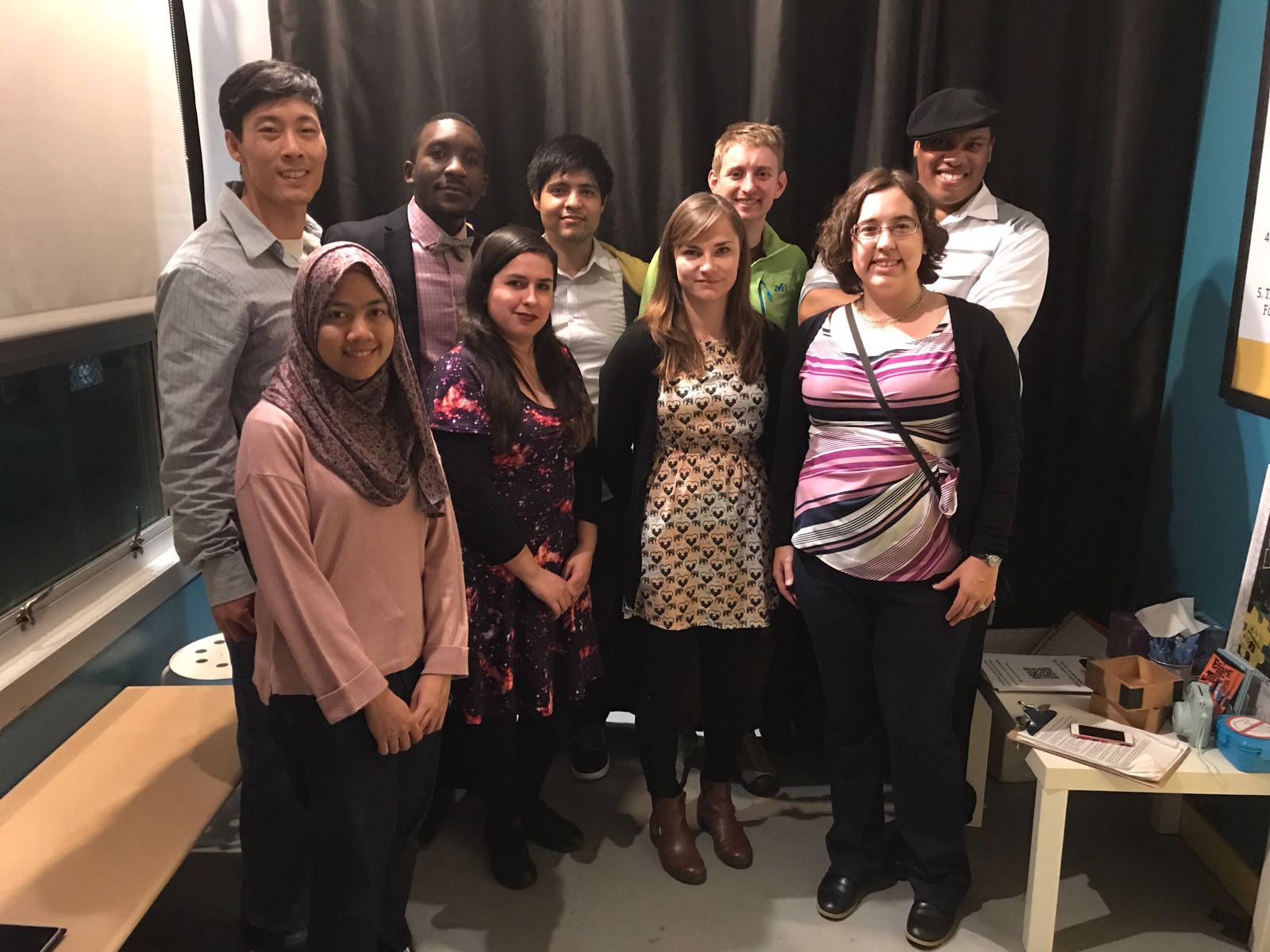
Team building at the hardest Escape Room in the USA, with SPIE 2018 SEaCarP committee and guests.

I have joined two SPIE committees in 2018, namely the SPIE Education Committee and Student and Early Career Professional ad hoc Committee. I feel privileged to be part of active discussions and have the opportunity to contribute to guiding the SPIE’s mission. I am excited to be taking part in projects that will be looking to enhance the society’s education endeavours and the participation of student and early career professionals (SEaCarP). As part of my Education “duties” I am working with a smaller sub-committee towards better understanding the impact that the society’s members have through their dedication to outreach and public engagement programs. SEaCarP discussions have focused on enhancing the member experience of early career professionals. If you would like to get in touch to discuss these projects, drop by my LinkedIn profile to talk some more.

This international meeting was a fantastic forum to contextualise my professional and personal development experiences. It has given me the space to ask questions and actively listen to colleagues and friends engaging with the community. It is also great to see familiar faces again and catch up on people’s progress in their work and careers.

You’ll hear more from me at least by August, where I will be in San Diego for the 2018 SPIE Optics + Photonics congress. Bye for now.

Thanks to Vahan Malkhasyan for the picture that was used as the featured image in this post.